If your husband, wife or partner died without a Will, you would probably expect their Estate to pass to you. For many couples, that seems so obvious that they never think to check.
But it doesn't always work that way. Depending on your family circumstances, children or even your partner's parents may also be entitled to a share.
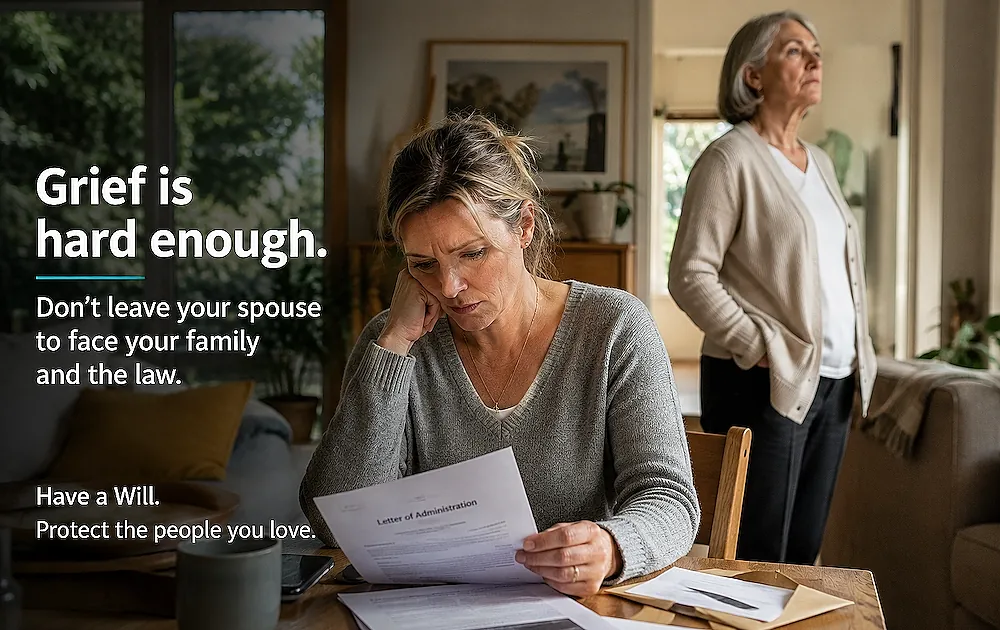 Without a Will, your Estate is dealt with under the default legal rules rather than the instructions you would have chosen yourself.
When someone dies without a valid Will, New Zealand law provides a set of default rules for dealing with their Estate. Those rules are necessary, but they are not personal. They do not know how your family actually works, what you have discussed around the dinner table, or what you would have wanted to happen.
You may have always thought of the house, savings and investments as belonging to you and your partner together. You may have raised a stepchild for most of their life and regard them exactly as you would a biological child. You may want your partner financially secure before anybody else receives anything. None of those intentions automatically becomes part of the legal process simply because your family knows about them.
There is also a practical side to dying without a Will that is easy to underestimate. Nobody has been nominated to take charge. Where formal administration is needed, someone has to work out who is entitled to apply, collect the information and documents the Court requires, obtain authority, deal with banks and other organisations, and then distribute the Estate according to the intestacy rules.
That work is not done by the person who died. It is left to the people around them.
So even if your own Will is already sorted, it is worth thinking about the people closest to you. Does your partner have one? What about your parents or your adult children? If they do not, their lack of a Will may one day become something you have to deal with.
Quick answer: what happens if you die without a Will in NZ?
If you die without a valid Will, you die intestate. Instead of following instructions you have left in a Will, your Estate is dealt with under the intestacy rules in the Administration Act 1969.
In practical terms, that can mean:
- You have not nominated an Executor to take charge
- Someone may need to apply to the High Court for letters of administration before they have authority to deal with the Estate
- The law decides which relatives inherit and the shares they receive
- Your spouse or partner may not receive the whole Estate
- Your children, parents, siblings or wider family may inherit, depending on who survives you
- Stepchildren, friends, charities and partners who do not qualify under the intestacy rules may receive nothing automatically
- If no entitled relatives can be found, the Estate may ultimately pass to the New Zealand Government
The important point is not that intestacy leaves your Estate with no rules. It leaves it with somebody else's rules. Your family cannot simply agree to distribute everything according to what they remember you saying. They have to deal with the Estate under the law, even where everyone knows you would have wanted something different.
Who gets your Estate if there is no Will?
That depends on who survives you. The rules start with a spouse, civil union partner or qualifying de facto partner, then move through children, parents, siblings and more distant relatives.
Community Law notes that de facto partners usually need to meet legal requirements, including the general three-year relationship rule, although exceptions may apply where there is a child of the relationship or a substantial contribution.
| Who survives you? |
What generally happens under NZ intestacy rules? |
| Partner, no children, no parents |
Your partner receives the whole Estate. |
| Partner and children |
Your partner receives personal chattels, $155,000 with interest, and one third of the rest. Your children share the remaining two thirds. |
| Partner and your own parents, no children |
Your partner receives personal chattels, $155,000 with interest, and two thirds of the rest. Your own parents share the remaining third. |
| Children, no partner |
Your children receive the whole Estate equally. |
| No partner, no children, your own parents survive |
Your own parents receive the whole Estate equally. |
| No partner, children or own parents, but siblings survive |
Your siblings receive the whole Estate equally. |
| No close family in the statutory list |
A search may be needed. If no entitled relatives can be found, the Estate may pass to the New Zealand Government. |
One rule catches a lot of couples by surprise
Take a fairly ordinary example. Your partner dies without a Will. You have no children together and they have no other children, but one or both of their parents are still alive.
In that situation, you do not necessarily receive the whole Estate. The surviving partner receives the personal chattels, the statutory $155,000 amount with interest, and two thirds of what remains. The deceased person's parents share the other third.
Put more simply, you can end up sharing part of your partner's Estate with your in-laws.
That does not mean your in-laws automatically receive one third of everything the two of you owned. Jointly owned assets may pass outside the Estate, and relationship-property rights can affect what is actually available for distribution. But once the Estate has been worked out, the parents' entitlement can still be very real.
Think about the situation rather than just the percentages. Your partner has died and you are already dealing with the funeral, the house, accounts, bills and all the practical things that suddenly need attention. At the same time, you may now be dealing with an Estate in which your in-laws have a legal financial interest. That may cause no difficulty at all in some families. In others, it can introduce exactly the sort of uncertainty and tension that the person who died would have wanted to avoid.
Things families often do not realise about dying without a Will
Most of the problems with intestacy begin with ordinary assumptions. Couples assume everything will go to each other. Parents assume the children will be looked after in the way they intended. Families assume someone sensible will simply step in and sort things out. Sometimes those assumptions are right. Sometimes they are not.
Your partner may not get everything
If you have a partner and children, your partner receives personal chattels, $155,000 with interest, and one third of what remains. Your children share the other two thirds.
For some families, that may be completely acceptable. For others it may create a real financial problem. If there is a mortgage, young children, one main household income or simply a surviving partner who expected to remain financially secure, the difference between receiving the whole Estate and receiving only part of it can matter a great deal.
Your parents may inherit alongside your partner
If you have a partner, no children and one or both of your parents are alive, your parents can share one third of the residue remaining after your partner's statutory entitlements.
Look at that from the surviving partner's side and the point becomes much clearer: they may have to share part of your Estate with their in-laws. That may be exactly what you want. If it is not, the time to deal with it is while you are still here to say so.
A stepchild you think of as your own may receive nothing automatically
This is particularly important in blended families. A stepchild does not automatically inherit under intestacy in the same way as a biological or legally adopted child unless they have been legally adopted.
You may have helped raise that child for fifteen years. They may call you Mum or Dad and everyone in the family may regard them as one of your children. The intestacy rules do not make that same judgement for you. If you want them included, you need to record that intention properly.
Nobody has been nominated to take charge
When you make a Will, you nominate an Executor. That person knows they have been chosen and, if a court grant is required, they can apply for probate in that role.
Without a Will, there is no nominated Executor waiting to step in. If formal administration is required, somebody has to establish that they are entitled to apply, gather the required documents and information, and ask the High Court to appoint them as administrator.
This is more than a technical difference. It can mean uncertainty about who should take responsibility, more work before anybody has clear authority to act, and additional time and expense before the Estate can move forward.
The Estate may have to wait while authority is sorted out
Banks, investment providers and other organisations may require proper legal authority before they will release or transfer Estate assets. Where letters of administration are required, the family cannot simply choose someone among themselves and carry on as though that person were the Executor.
The application has to be prepared and filed, and the applicant has to show that they are entitled to apply. Depending on the circumstances, further evidence or consents may also be required. There is a Court filing fee, and if legal or other professional help is needed, those costs may also come out of the Estate.
More importantly, all of this takes time. While the legal authority is being sorted out, there may still be a house to maintain, bills to pay, accounts to deal with and a family trying to work out what happens next.
People who mattered to you may fall outside the rules completely
A close friend, a charity, or a stepchild who has not been adopted does not inherit simply because they were an important part of your life.
The law does not know that your niece should have your books, that you promised a treasured item to a friend, or that you wanted to leave something to a cause you cared about. Those are personal decisions, and if they matter to you, they need to be written down.
Your family cannot supply the missing instructions afterwards
You may have perfectly good reasons for wanting one person to receive more than another. Perhaps you helped one child buy a house years ago. Perhaps protecting your partner is your first priority. Perhaps there is a relative you do not want involved at all.
Your family may know exactly what you wanted. The problem is that once you are gone, their memory of those conversations is not a substitute for a valid Will.
Already have a Will? Think about the people close to you.
Is your partner still meaning to make one? What about your parents, your adult children, or somebody close to you in a blended family?
If this article made you think of someone, send it to them. It does not need to become a heavy conversation about death. You can simply ask:
"Do you actually know what would happen to your Estate if you died without a Will?"
What does dying intestate mean?
It simply means dying without a valid Will that deals with your Estate.
If you have a Will, you have already nominated the person you want to act as Executor and left written instructions about how you want the Estate distributed. If a court grant is required, the Executor can apply for probate in the role you gave them.
Without a Will, that starting point is missing. Where formal authority is needed, somebody has to apply for letters of administration. Once appointed, the administrator does much of the same practical work as an Executor: finding and collecting assets, paying debts and expenses, dealing with tax, keeping records and eventually distributing what remains.
The important difference is that the administrator is not there to reconstruct what you probably meant. They have to administer the Estate according to the intestacy rules.
This is why saying "my family knows what I want" is not really enough. They may know perfectly well, but that does not give them the same authority or freedom to carry out those wishes as a valid Will would.
For more detail on how probate works and how to apply for it, read our Complete Guide to Probate in NZ.
Letters of administration: what happens when there is no Executor?
Not every Estate needs a High Court grant. Some smaller assets may be released without formal administration, depending on the asset, the organisation holding it and the circumstances.
But where formal authority is required and there is no Will, somebody needs to obtain letters of administration on intestacy before they have the legal authority to administer the Estate. Instead of the Executor you nominated stepping into the role, a person first has to establish their right to apply and ask the High Court to appoint them.
That may involve:
- Making sure no valid Will can be found
- Working out who is entitled to apply
- Obtaining consents or dealing with competing entitlement issues where required
- Identifying the Estate assets and debts
- Preparing and filing the High Court application
- Waiting until authority has been granted before dealing with assets that require it
- Paying debts, expenses and tax
- Distributing the Estate according to the intestacy rules
There is a Court filing fee, and legal or other professional fees may be incurred if help is needed with the application or the administration of the Estate. There is also the less visible cost: time. Every additional document, consent, question about entitlement or delay in obtaining authority is something the family has to deal with before they can finish the job.
A Will does not make every Estate instant or inexpensive. Probate can still take time and Estates can still be complicated. What a Will does is remove a major area of uncertainty. You have already nominated the person you want to take charge and left them instructions to work from.
What a Will lets you decide
A Will gives you the chance to make these decisions yourself while you still can. You choose who takes charge, who should benefit and, within the law, how you want your Estate dealt with. Just as importantly, the people left behind have something clear to work from instead of having to rely on default rules and family assumptions.
With a Will, you can usually decide:
- Who your Executor should be
- Who your backup Executor should be
- Who receives your Estate
- How you want to provide for your partner, children, stepchildren, friends or charities
- Who receives personal items or specific Gifts
- Who you would like appointed as Guardian for children under 18
- What happens if a first-choice Beneficiary dies before you
- Whether a sensitive decision should be explained in a Statement of Wishes
The intestacy rules may happen to produce exactly the result you would have chosen yourself. If they do, that is fine. The important thing is to know that now, rather than have your family discover after your death that the legal result is not what anyone expected.
Make the decisions while they are still yours
Will Kit Generator guides you through Executors, Beneficiaries, Guardians, Gifts, Estate residue and signing instructions in plain English.
Start your Will now
Family situations where a Will matters even more
Blended families
Blended families often have arrangements and relationships that a simple legal formula cannot capture. You may want to look after your current partner while also protecting children from an earlier relationship. You may have stepchildren you regard as your own, or particular family items you want to stay with one side of the family.
If that sounds like your family, relying on intestacy is particularly risky because the law cannot fill in those details for you.
Unmarried partners and newer de facto relationships
A spouse, civil union partner or qualifying de facto partner may inherit under intestacy, but de facto relationships have legal thresholds. A newer relationship may therefore not be treated in the way the couple assumes.
If providing for your partner is important to you, it is much safer to deal with that deliberately in a Will than to rely on an assumption about how the relationship will be classified later.
Children under 18
A Will lets parents name testamentary Guardians. That does not decide every question about a child's day-to-day care, but it does leave clear evidence of the people you trust to have an important role if you die.
Without a Will, that written expression of your wishes simply is not there.
Stepchildren
If there is a child you regard as part of your family who is not your biological or legally adopted child, do not assume the intestacy rules will treat them the same way you do.
If you want them to inherit, put that intention in a valid Will.
Personal Gifts, charities and friends
Intestacy deals with legal relationships, not the personal history behind them. It does not know that your niece has always loved your books, that a close friend helped you through a difficult period, or that a particular charity has mattered to you for years.
If you care where those things go, record it properly.
How to avoid dying intestate
The practical answer is not complicated: make a valid Will, sign it correctly, keep the original somewhere safe, and review it when your life changes.
A useful checklist:
- Choose your Executor and backup Executor
- Choose your Beneficiaries and backup Beneficiaries
- Decide who receives your Estate residue
- Add specific Gifts if needed
- Name Guardians if you have children under 18
- Add a Statement of Wishes if an explanation would help
- Print the final Will
- Sign it in front of two suitable witnesses
- Store the original where your Executor can find it
- Review it after major life changes
For the full process, read How to Make a Will in NZ. If you want to see what a finished document can look like, have a look at our Sample New Zealand Will.
Will Kit Generator helps New Zealanders create a clear, plain-English Will online for a fixed upfront price. You can preview before paying and appoint your own Executors.
Intestacy FAQs
What happens if you die without a Will in NZ?
You die intestate. Your Estate is distributed under the Administration Act 1969 instead of under instructions in a Will. Someone may need to apply for letters of administration before they can deal with Estate assets.
Who inherits if there is no Will in New Zealand?
It depends on who survives you. The rules generally start with a spouse, civil union partner or qualifying de facto partner, then children, parents, siblings, grandparents, and uncles and aunts.
Does everything go to my spouse or partner if I die without a Will?
Not always. If you have a partner and children, your partner receives personal chattels, $155,000 with interest, and one third of the rest. Your children share the remaining two thirds.
Can my in-laws inherit if my partner dies without a Will?
Potentially, yes. If your partner dies leaving you as their surviving partner, has no children, and one or both of their parents are alive, their parents can be entitled to share one third of the residue remaining after the surviving partner's personal chattels and statutory $155,000 amount with interest. Joint ownership and relationship-property rights can also affect what property actually forms part of the Estate.
What do children receive if there is no Will?
If there is no surviving partner, the children receive the whole Estate equally. If there is a surviving partner, the children share the portion allocated to them under the intestacy rules.
Can parents inherit if there is no Will?
Yes. Parents can inherit where there are no children, including where there is also a surviving partner. In the partner-and-parents situation, the deceased person's parents share one third of the residue remaining after the partner's statutory entitlements.
What are letters of administration?
Letters of administration are a High Court order appointing an administrator and giving that person authority to deal with an Estate. They are commonly relevant where there is no Will and formal authority is required.
What is the difference between probate and letters of administration?
Probate usually applies where there is a valid Will and an Executor can act. Letters of administration commonly apply where there is no Will, or in some circumstances where there is a Will but no Executor can act.
Can stepchildren inherit if there is no Will?
Not automatically in the same way as biological or legally adopted children unless they have been legally adopted. If you want a stepchild to inherit, a valid Will is the clearest way to record that intention.
What happens if no relatives can be found?
A search may be carried out to identify next of kin. If no entitled relatives can be found, the Estate may pass to the New Zealand Government.
How do I avoid dying intestate?
Make a valid Will, sign and witness it correctly, keep the original safely, and review it after major life changes.
So, what should you take from all of this?
Dying without a Will does not mean there is no process for dealing with your Estate. There is. The problem is that you have given up a lot of control over both the process and the outcome.
You have not nominated the person you trust to take charge. If formal authority is required, somebody has to establish their right to act and apply for it. That can mean Court paperwork, waiting, filing costs and possibly professional fees before parts of the Estate can be dealt with. Once the Estate is ready to distribute, the intestacy rules decide who receives what.
Depending on your family, that could leave your partner sharing the Estate with children or, in some cases, with your parents. A stepchild you regard as one of your own may receive nothing automatically. Friends and charities are outside the normal family formula. And whatever the result, the people close to you are the ones who have to work through the administration.
Perhaps those default rules are exactly what you would choose. But if you have never checked, you do not actually know.
A Will lets you make the decisions yourself and gives the people dealing with your Estate a much clearer starting point.
Did this make you think of someone?
Maybe it is your partner, one of your parents, an adult son or daughter, a sibling or a close friend who still has not made a Will.
If so, send them this article. You do not need to make a big thing of it. Something as simple as "I didn't realise this was how it worked. Have a read when you get a chance." is enough to start the conversation.