Making a Will in New Zealand does not require a lawyer appointment, court approval, or a Justice of the Peace - but it does require clear decisions, correct signing, and a document your Executor and family can understand and follow.
This guide walks you through the practical steps needed to make a clear NZ Will, compares the main ways to make a Will in New Zealand, and helps you choose the process that gives you the right mix of clarity, control, cost and support.
 In New Zealand, correct signing and witnessing turns a prepared Will into a completed Will.
What your Will needs to do
Making a Will is not just paperwork. It is a set of instructions that speaks for you once you are gone - who you put in charge, who receives your property, who cares for your children, and what your intentions actually were. When your Will is clear, it guides the people left behind, reduces confusion, and lowers the risk of conflict. When a Will is unclear or absent, those same people are left to guess, negotiate, or pay for help to work it out.
Without a Will, a surviving partner may have no automatic right to the family home if the Estate passes under intestacy rules. That is the kind of uncertainty a clear Will prevents.
A well-made New Zealand Will answers these core questions:
- Who will administer your Estate?
- Who should receive your Estate, and in what shares?
- Who should receive specific Gifts or personal items?
- Who should be appointed Guardian if you have children under 18?
- What happens if your first choice of Executor or Beneficiary cannot act or has died?
- Are there decisions that should be explained in a Statement of Wishes - a document that sits alongside your Will to explain your intentions and personal preferences?
- Where will the original signed Will be stored?
Once those decisions are clear, the practical process follows naturally. The harder question for most people is not how to fill in a form.
It is: what process gives you enough structure, clarity, and support to produce a Will your Executor and family can actually follow?
The main ways to make a Will in NZ
How you make your Will matters almost as much as what it says. The way you choose determines how much guidance you get, how clear the final wording is, how much control you keep over who administers your Estate, and what fees or obligations may be sitting quietly in the background.
Most New Zealanders choose from four broad Will-making methods:
- DIY Will templates - paper or downloadable forms
- Online guided Will services - interactive builders, such as Will Kit Generator
- Lawyer-drafted Wills - custom legal advice from a law firm
- Trustee-company services - Public Trust or corporate trustees
Each of these can produce a valid Will, provided the final document is completed, printed, signed, and witnessed correctly. The real differences are the level of guidance you receive, the upfront cost, the clarity of the final wording, who you appoint as Executor, and what future costs or obligations your Estate may carry as a result.
How the methods compare
Pricing and processes vary by provider, so check current terms before signing or paying. The upfront cost is rarely the whole picture. What matters just as much is the guidance you receive, the control you keep over Executor choice, and what costs or obligations may follow the arrangement.
1
DIY templates
Low upfront cost. Often free, cheap, downloadable or printed.
Best fit
People who already know exactly what they need, can compare forms carefully, and are confident about wording, residue, backups and signing.
Main watch-outs
Multiple form versions, rigid or legalistic wording, no guided prompts for backups or residue, and mistakes that may only surface later.
2
Guided online Will
Lower-cost fixed-price guided process. Will Kit Generator's guided online Will is $99.
Best fit
Most NZ family and asset situations where the Will-maker wants structure, plain English, control and an upfront price.
Main watch-outs
The Will still needs to be printed, signed and witnessed correctly. Online completion alone is not enough. If you are unsure about wording, contact Mathew via the Contact page or live chat.
3
Lawyer-drafted Will
Often $400+ for a simple Will, with higher costs for more involved advice, meetings, changes or related legal work.
Best fit
People who need specialist legal advice beyond the Will itself, or who want a fully lawyer-led process.
Main watch-outs
Higher cost, appointment time, formal process, and documents that can be harder for ordinary families to follow. The value depends on whether the extra legal work is needed for your situation.
4
Public Trust-style service
Costs vary. Some services advertise entry-level Will pricing, with additional storage, Executor or Estate administration options.
Best fit
People who want institutional support or do not have someone suitable to appoint as an Executor personally.
Main watch-outs
Read Executor and Estate-administration terms carefully. Some arrangements can involve significant unexpected Estate administration fees and other commitments later.
Option 1: DIY Will templates - paper or downloadable forms
DIY Will templates can look appealing - low cost, instant access, and no appointments.
The risk is not the idea of writing your own Will. The risk is that a blank form leaves the hard decisions entirely to you.
A blank template does not ask whether you have named a backup Executor. It does not flag an incomplete residue clause - the part of your Will that gives everything not specifically named a clear destination. It does not prompt you to think about what happens if a Beneficiary dies before you do. It does not explain the witnessing rules.
Common problems with DIY templates include:
- Choosing between multiple available forms without knowing which one applies
- Instructions that are unclear, legal in style, or hard for ordinary people to follow
- Leaving the residue of the Estate unclear or unaddressed
- Wording that is too generic or rigid for the actual family situation
- Missing prompts for backup Executors and backup Beneficiaries
- Poor handling of Guardians for children under 18
- No guided prompts for specific Gifts, personal items, or digital assets
- No Statement of Wishes to explain important choices
- Signing or witnessing mistakes that can affect the Will's validity
A form can look complete and still leave real problems for the people who have to use it when it matters most.
A DIY template may be enough if your wishes are simple to express, you already know what wording you need, and you are confident about the signing and witnessing rules. For most people, a guided process is safer and clearer - because it asks the questions a blank form never will.
Option 2: Online guided Will services, such as Will Kit Generator
An online guided Will service is fundamentally different from filling in a blank template.
Instead of starting with an empty document, you answer structured questions. Your answers build the Will in the background as you go. You can review the document, adjust your answers, and check whether the Will reflects what you actually want.
Will Kit Generator guides you through:
- Executors and backup Executors
- Beneficiaries and backup Beneficiaries
- Guardians for children under 18
- Specific Gifts and personal items
- The residue of your Estate
- Wishes and explanations
- Signing and witnessing instructions
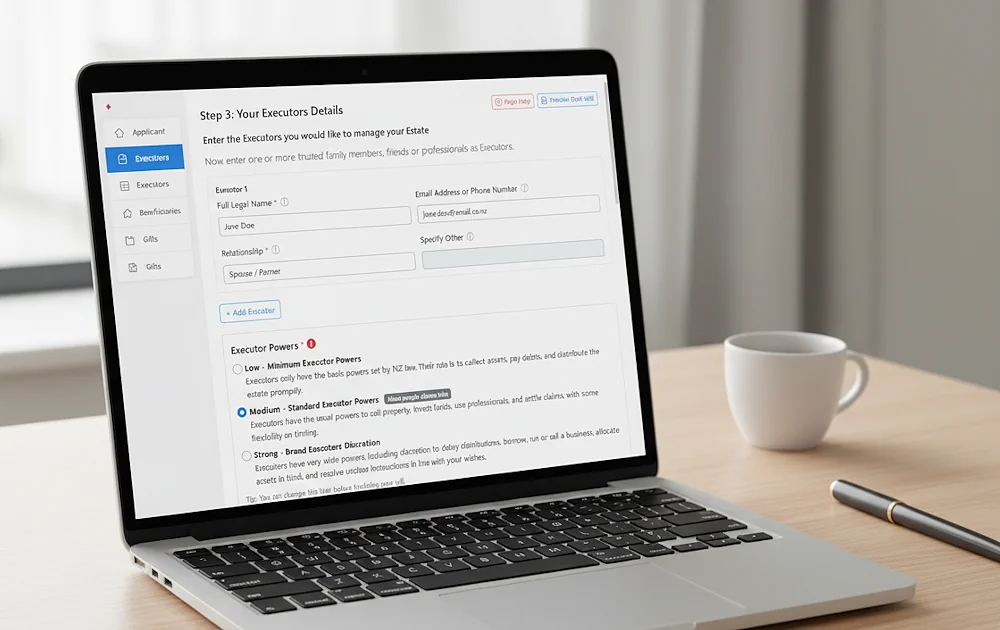 Will Kit Generator uses guided prompts so you can create a New Zealand Will without starting from a blank template.
The aim is transparency and control. You can see your Will before paying, appoint your own Executor, and get plain-English wording - without being locked into a professional Executor arrangement you did not choose.
That matters because a Will is not only a legal document. It is also a practical instruction document for the people left behind. Clear wording gives your Executor a clearer mandate and gives your family a clearer picture of what you intended.
The finished Will still needs to be printed, signed and witnessed correctly. Online completion alone is not enough.
If you have questions, blended-family concerns, possible family sensitivity, unequal Gifts, exclusions, trusts, business ownership, overseas assets or wording uncertainty, contact Mathew or use live chat at the bottom right of the screen. These situations do not automatically require a lawyer. They do mean the wording, safeguards and any explanations need to be handled with care.
Option 3: Lawyer-drafted Wills - custom legal advice from a law firm
A lawyer-drafted Will is most useful when the work requires specialist legal advice beyond the Will itself: complex trust restructuring, business succession planning, relationship property issues, advice across multiple countries, serious capacity concerns, or active disputes.
Some people also prefer the comfort of a lawyer-led process, particularly where they want someone else to manage the drafting from start to finish.
The trade-off is cost, time, and process. Citizens Advice Bureau states that for a simple lawyer-drafted Will, you can expect to pay an upfront fee of $350 to $500, with more complex work costing more. Appointments, back-and-forth, and follow-up can add significant time on top of that.
Some lawyer-drafted Wills are clear, well explained, and easy to follow. Others use formal legal language that is harder for ordinary families to interpret without help - meaning that when the time comes, the people left behind may need to involve a lawyer or other professional just to understand what the Will says and what they are entitled to do. That adds cost, delay, and outside involvement at a time when families should be in control.
The key question is not whether a lawyer drafted the document. It is whether the people who need to use it - your Executor, your family, your loved ones - can actually follow it without needing to pay someone to explain it to them.
For many common NZ Will situations, a guided online Will gives more control, clearer language, and a faster, more affordable path. Where you need specialist legal advice, use a lawyer. Where you need help working through wording, safeguards or sensitive decisions within the Will, contact Mathew or use live chat at the bottom right of the screen.
Option 4: Trustee-company services - Public Trust or corporate trustees
Public Trust and trustee-company services can prepare Wills, store documents and provide Estate administration. They can suit people who want institutional support, or who do not have someone suitable to appoint as Executor personally.
The key issue is not whether these organisations can prepare a Will. The key issue is whether you understand the entire arrangement you are entering into.
A low or reasonably advertised Will price is not always the whole story. The bigger question is whether you are simply buying a Will or also appointing the organisation to administer your Estate after you die.
Before using a trustee company or Public Trust-style service, ask:
- Am I buying a Will only, or also appointing this organisation as Executor?
- Can I appoint my own Executor instead?
- What will my Estate pay after I die?
- Are Estate fees fixed, hourly, percentage-based, or some combination?
- What work is included?
- What work may cost extra?
- What happens if my family wants flexibility later?
Some trustee-company or professional Executor arrangements can involve significant unexpected Estate administration fees later. That does not mean these services are wrong for everyone. It means understanding those terms before you pay or sign is what actually protects your Estate.
Will Kit Generator is built around transparency and keeping control of your Estate within your family. You choose your own Executors, preview your Will before paying, and create a plain-English document that you and your family can understand, at a fixed upfront price.
Which Will-making option fits your situation?
The right option is not always the most formal or expensive one. The right option is the one
that gives you enough structure, clarity, control and support for the decisions you need to make.
-
Use a DIY template only if you already know exactly what wording you need,
your wishes are easy to express, you can compare the form options carefully, and you are
confident about signing and witnessing.
-
Use Will Kit Generator or another guided online service if you want
structure, plain-English prompts, clear Executor and Beneficiary choices, Guardian sections,
Estate residue, Gifts, Wishes, control over who administers your Estate, and a fixed upfront cost.
-
Use a lawyer-drafted Will if you need specialist legal advice beyond the Will itself,
such as trust restructuring, tax advice, complex business succession advice, advice across
multiple countries, active litigation, or a serious legal dispute.
-
Use a trustee company or Public Trust-style service if you want institutional support,
do not have a suitable personal Executor, and are comfortable with the Executor, storage,
administration and fee terms. Before signing, make sure you understand whether you are appointing
the organisation as Executor and what your Estate may pay later.
If you are unsure about wording, blended-family concerns, possible family sensitivity, unequal Gifts,
exclusions, trust questions, business ownership or overseas assets, contact Mathew
or use live chat.
See how Will Kit Generator works
If you are considering making your Will online, the quickest way to understand the process is to see it in action. The short demo shows how Will Kit Generator guides you through the main decisions without starting from a blank template.
Watch the 1-minute demo
See how Will Kit Generator helps you create a plain-English NZ Will online.
Watch the Demo
How to make your Will step by step
Once you have chosen the right Will-making option, the actual process is practical.
The goal is to make clear decisions, record them in the right places, check the document carefully,
and then sign and store the final Will properly.
Step 1: Start with people and responsibilities, not assets
The instinct is to start with a list of what you own. The better starting point is the people your Will needs to protect and the responsibilities it needs to assign.
Think about your partner, children, stepchildren, parents, siblings, close friends, charities, pets, and anyone who depends on you. When those people are clear in your mind, the decisions that follow - who administers, who receives, who cares for children - become much easier to work through.
When the decisions are clear, the Will is easier to create and much harder for others to misunderstand.
Step 2: Choose your Executor and backup Executor
Your Executor is the person who carries out your Will after you die. They may need to find your Will, apply for probate if required, collect assets, pay debts, keep records, communicate with Beneficiaries, and distribute the Estate. It is a real responsibility that can take months.
Choose someone you trust who is organised, practical, and able to communicate clearly. It is also advisable to name a backup Executor - your first choice may have died, moved overseas, become unwell, or simply be unable to act when the time comes.
An Executor can also be a Beneficiary. Many people appoint a spouse, partner, adult child, sibling or trusted friend.
Step 3: Choose Beneficiaries and backup Beneficiaries
Your Beneficiaries are the people or organisations who receive something from your Estate. You can leave specific Gifts, divide the Estate by percentages, leave Gifts to charities, or combine these approaches.
Backup Beneficiaries matter because life changes. A person may die before you. A charity may change its name or structure. A relationship may end. Your Will should still have a clear destination if your first Beneficiary choice cannot receive.
Step 4: Appoint Guardians if you have children
Parents with children under 18 should appoint Guardians in their Will. Even where you expect family members to agree, naming Guardians gives clear evidence of who you trust to be involved in important decisions for your children.
A testamentary Guardian does not automatically settle every day-to-day care issue in every possible situation, but it is still one of the clearest ways to record who you trust and what you want considered.
Think about who shares your values, who your children know and trust, who can communicate well with your family, and whether location matters. A backup Guardian is worth including too.
In Will Kit Generator, you can record special Guardian arrangements or use your Statement of Wishes to explain routines, schooling, culture, faith, family relationships, or other matters that are important to you.
Step 5: Decide on specific Gifts, Estate residue and personal items
Specific Gifts are particular items or amounts you want to leave, such as jewellery, vehicles, tools, family items, savings, or charity Gifts.
The Estate residue is everything left after debts, expenses and specific Gifts are dealt with. A clear residue clause is one of the most important parts of any Will because it gives everything not specifically named a clear destination. Without it, assets that were not individually listed may have no clear path.
Describe important items clearly enough for your Executor to identify them. If a specific Gift is emotionally sensitive, you can leave special instructions or a short explanation in your Statement of Wishes to reduce confusion later.
Step 6: Add a Statement of Wishes where useful
Your Will gives legal instructions. A Statement of Wishes is a separate document that sits alongside your Will to record your personal preferences and explain the intentions behind your decisions. It does not override the Will - its job is to give context.
You might use a Statement of Wishes to record:
- Funeral preferences
- Digital accounts and password access instructions
- Pet guardianship and care
- Personal messages
- Why you may have made unequal Gifts
- Why you may have excluded someone
- What you hope your family will understand
This can be especially valuable where a decision might otherwise surprise or confuse the people left behind.
Step 7: Review your Will carefully before signing
Read the whole Will before signing. Check every name, every spelling, every relationship description, every Executor and Beneficiary choice, every percentage, every Gift, and every set of signing instructions.
At this stage, it is worth printing your draft Will, reading it properly, sleeping on it, and making any updates before signing.
Your final Will checks should include:
- Does this reflect what I actually want?
- Have I named backups where needed?
- Does the residue of my Estate have a clear destination?
- Could my Executor follow this document without help?
- Is there anything a Statement of Wishes should explain?
This is the step where problems are easiest to fix. With Will Kit Generator, you can preview and print your Will for review, then make updates for 30 days after purchase. Extensions are available if you need more time.
Ready to start your Will?
Will Kit Generator guides you step by step through Executors, Beneficiaries, Guardians, Estate residue, Gifts, Wishes and signing instructions - in plain English.
Start your Will now
Step 8: Print, sign and witness your Will correctly
Completing an online questionnaire is not enough by itself. The Will must be printed and signed with pen before it is complete.
You do not need a lawyer, Justice of the Peace, solicitor, court official, or specialist witness. You need two suitable witnesses.
Under the Wills Act 2007, the will-maker signs the Will, or acknowledges their existing signature, in the presence of both witnesses at the same time. Both witnesses then sign in the will-maker's presence.
Your witnesses should:
- Be over 18
- Be present together at the time of signing and witnessing
- Be able to see you sign or acknowledge your signature
- Not be Beneficiaries under the Will
- Not be the spouse, civil union partner, or de facto partner of any Beneficiary
Sign in pen. Keep the original. Do not rely on a scan or photocopy as a substitute for safe storage of the signed original document.
Step 9: Store the original Will safely
Store the original signed Will somewhere your Executor can find it when needed and tell your Executor where it is kept. Common options include a secure place at home, with a lawyer or professional adviser such as an accountant, or another safe location your Executor knows about.
Do not hide it so thoroughly that nobody can find it. A Will that cannot be located creates many of the same practical problems as having no Will at all.
Step 10: Review and update your Will when life changes
A Will made today reflects today's life. It should change when your life changes.
Review your Will after major life changes, such as:
- Marriage or civil union
- Separation or divorce
- A new child or grandchild is born
- Buying or selling property
- A major asset change
- A change in Executor, Beneficiary or Guardian
- Moving overseas
- Significant changes to family relationships
Marriage or civil union can affect an existing Will, particularly if the Will was not made in contemplation of that marriage or civil union. With Will Kit Generator, you can update your answers, generate an updated Will, and sign the new version correctly. The valid Will is generally the most recent properly signed version, so clear dating and safe storage both matter.
Common Will writing mistakes to avoid
Most Will problems are avoidable. They usually come from one of four things:
unclear decisions, unclear wording, incorrect signing, or people not understanding what they agreed to.
These mistakes may not show up while the Will-maker is alive. They usually show up later,
when the Executor and family are trying to use the Will.
When making a Will, watch out for these common traps:
- Using the wrong DIY form or not knowing which form applies
- Relying on generic wording without checking whether it fits your situation
- Forgetting to name an Estate residue Beneficiary
- Not naming a backup Executor
- Not naming backup Beneficiaries
- Not appointing Guardians for children under 18
- Using a Beneficiary, or a Beneficiary's partner, as a witness
- Treating online completion as enough without printing, signing and witnessing the Will correctly
- Appointing a professional Executor or trustee company without understanding the fee or commitment structure
- Not updating the Will after marriage, civil union, separation, new children, property changes or major family changes
- Storing the original Will somewhere nobody can find it
- Failing to explain sensitive decisions where a short note could reduce confusion or conflict
The pattern is simple: a Will is strongest when the decisions are clear, the wording is clear,
the signing is correct, and the original signed document can be found.
How Will Kit Generator simplifies the Will-making process
Will Kit Generator gives New Zealanders a guided, plain-English way to create a Will online, without starting from a blank page and without the cost and process of traditional lawyer drafting.
The service is built around transparency and control. You answer structured questions, the Will is built from your answers, and you can preview the finished document before paying.
The guided Will service includes:
- A step-by-step Will building process based on your answers
- A plain-English structure built around your decisions, not a generic form
- Transparent $99 fixed pricing
- Preview before paying
- 30 days of updates after purchase, with extensions available
- The ability to appoint your own Executors
- Structured sections for Executors, Beneficiaries, Guardians, Gifts, Estate residue, Wishes and signing
- A Will you and your family can understand and follow
- The option to contact Mathew or use live chat if you are unsure about wording, safeguards or family-sensitive decisions
That gives the Will-maker and their loved ones more transparency and control over the decisions that matter.
Clear wording cannot prevent every possible challenge or disagreement. But it gives your Executor a clearer mandate, gives your family a clearer picture of your intentions, and can reduce confusion and lower conflict risk when it matters most.
You can also view a sample New Zealand Will to see what the finished document looks like before you start.
Common Will-making questions
Do I need a lawyer to make a Will in NZ?
No. A New Zealand Will does not need to be prepared by a lawyer to be valid. Many New Zealanders can make their own Will if they understand what they are doing, make the Will freely, and sign and witness the final document correctly.
A lawyer can still be useful where specialist legal advice is genuinely needed, such as complex trusts, business succession, overseas assets, active disputes, or legal issues beyond the Will itself.
Can I make a Will online in New Zealand?
Yes. An online Will service can help you create the Will document. The important point is that the online process is only the document-creation step.
The finished Will still needs to be printed, signed in pen, witnessed correctly by two suitable witnesses, and stored safely before it is complete.
Are online Wills legally valid in NZ?
Yes. A Will made online can be legally valid in New Zealand if the Will-maker understands what they are doing, makes the Will freely, and the final document is signed and witnessed correctly.
Online completion alone is not enough. The physical signing and witnessing step is what turns the prepared document into a completed Will.
Does my Will need to be signed by a lawyer or Justice of the Peace?
No. A New Zealand Will does not need to be signed by a lawyer, Justice of the Peace, solicitor, court official, or specialist witness.
The Will-maker needs to sign the Will, or acknowledge their signature, in the presence of two suitable witnesses who are present at the same time. Those witnesses then sign in the Will-maker's presence.
How much does it cost to make a Will in NZ?
The cost depends on the option you choose. DIY templates may be low-cost or free. Will Kit Generator's guided online Will is $99. Lawyer-drafted Wills often cost several hundred dollars, with more complex legal work costing more.
Also check whether a provider is only preparing the Will or whether you are also appointing them as Executor. Upfront Will costs and later Estate administration fees are separate things.
What information do I need before making a Will?
It helps to have your full legal name and address, your Executor and backup Executor choices, Beneficiary details, backup Beneficiary choices, Guardian choices if you have children under 18, and any specific Gifts you want to make.
You do not need to list every asset in detail for every Will. What matters is that the Will clearly says who should receive your Estate and who should deal with it.
Who should I choose as Executor?
Choose someone you trust who is organised, reliable, practical, and able to communicate clearly. Your Executor may need to find the Will, apply for probate if required, collect assets, pay debts, communicate with Beneficiaries, and distribute the Estate.
It is also sensible to name a backup Executor in case your first choice cannot act.
Can my Executor also be a Beneficiary?
Yes. In New Zealand, an Executor can also be a Beneficiary. This is common, especially where a spouse, partner, adult child, sibling, or trusted friend is appointed as Executor.
The more important point is whether the Executor is suitable for the role and likely to handle the responsibility properly.
Who can witness my Will?
You need two suitable witnesses who are present together and can see you sign or acknowledge your signature. They should then sign the Will in your presence.
Avoid using anyone who receives a Gift under the Will, or the spouse, civil union partner, or de facto partner of a Beneficiary.
Can a family member witness my Will?
A family member can witness a Will if they are independent and suitable. That means they should not be a Beneficiary under the Will, and should not be the spouse, civil union partner, or de facto partner of a Beneficiary.
If there is any doubt, choose someone else. Witnessing is one of the easiest parts of a Will to get right, and one of the most frustrating to fix later if handled badly.
Should I appoint Guardians if I have children under 18?
Yes. Parents with children under 18 should appoint Guardians in their Will. This gives clear evidence of who you trust to be involved in important decisions for your children.
A testamentary Guardian does not automatically settle every day-to-day care issue in every possible situation, but it is still one of the clearest instructions a parent can leave.
What happens if I die without a Will?
If you die without a Will, you die intestate. Your Estate is then dealt with under New Zealand intestacy rules instead of your own written instructions.
That means you do not clearly choose your Executor, Beneficiaries, Guardians, Gifts, Estate instructions, or wishes. Your family may also face more uncertainty at an already difficult time.
How often should I update my Will?
Review your Will after any major life change, including marriage, civil union, separation, a new child, buying or selling property, a change in Executor or Beneficiary, or a significant shift in family circumstances.
A Will should reflect your current life, not just the life you had when you first wrote it.
Does marriage or civil union affect an existing Will?
Yes, it can. Marriage or civil union can affect an existing Will, particularly if the Will was not made in contemplation of that marriage or civil union.
Review your Will before or soon after any major relationship change.
What if I have a blended family, unequal Gifts, or possible family sensitivity?
These are common Will-making situations. They do not automatically mean you cannot use an online Will service. They do mean the wording, safeguards, backup choices, and explanations matter.
Clear wording and a well-structured Statement of Wishes can help explain your intentions and reduce confusion later. If you are unsure how to word a decision, protect a Gift, explain an exclusion, or handle a blended-family concern, contact Mathew or use live chat.
Why should I understand the fees before appointing a professional Executor?
A professional Executor or trustee company may be the right choice for some Estates, but the appointment can shape what your Estate pays after you die.
Upfront Will costs and ongoing Estate administration fees are separate things. Before appointing a professional Executor or trustee company, understand the Executor role, the fee structure, what work is included, what may cost extra, and whether your family will have flexibility later.
Final word
A good Will gives your Executor and family clear instructions when they need them most. It says who is in charge, who receives what, who should care for children, and what your loved ones should understand.
That clarity does not require an expensive process, but it does require real decisions, clear wording, correct signing and safe storage.
Will Kit Generator sits between blank templates and traditional lawyer-drafted documents. It gives many New Zealanders a guided, transparent, plain-English path to a properly structured Will, at a fixed upfront price, with the ability to appoint their own Executors and preview the finished document before paying.
The signing matters. The backup choices matter. The Estate residue matters. Understanding Executor and trustee-company fees matters.
If anything in your situation needs more thought, including wording, safeguards, family sensitivity, trusts, business ownership or overseas assets, reach out to Mathew using the Contact page or live chat.
Start your Will at Will Kit Generator - and create something your family can actually follow.